

Singapore introduces fines for disruptive behaviour on buses
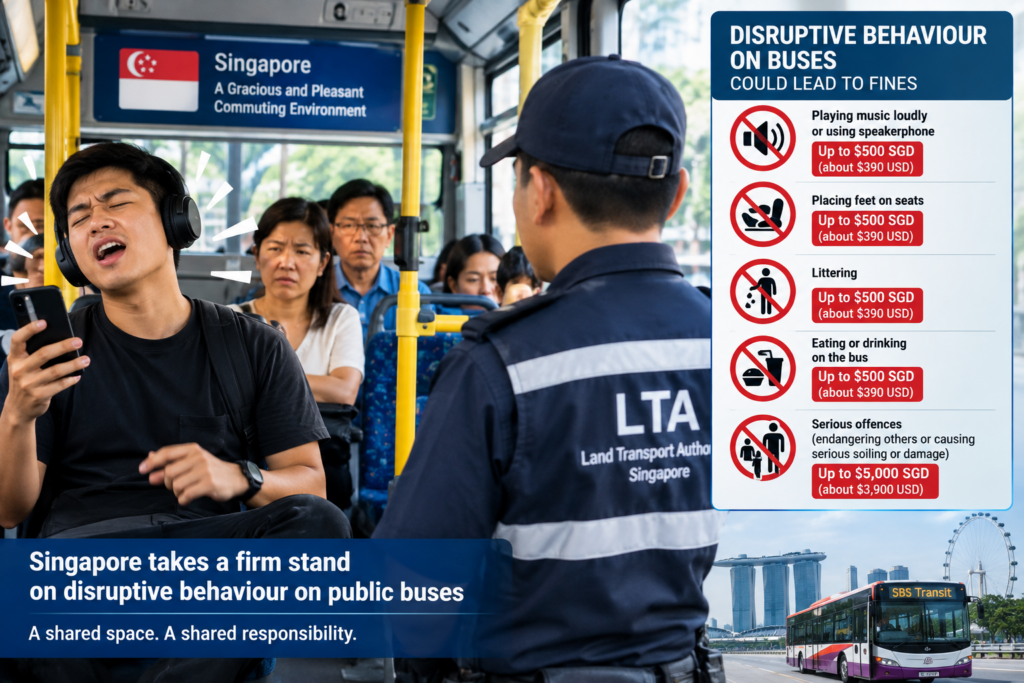
Singapore has introduced tougher penalties for passengers whose behaviour disturbs other commuters on public buses.
Under the new rules, passengers could be fined up to 500 Singapore dollars (about 390 U.S. dollars) for behaviours such as playing music loudly, placing their feet on seats, littering, eating or drinking on buses.
More serious offences, including actions that endanger other passengers or cause damage or serious soiling of public transport facilities, could attract fines of up to 5,000 Singapore dollars (about 3,900 U.S. dollars).
The Land Transport Authority (LTA), which oversees public transportation in Singapore, said the measures were aimed at promoting a more pleasant and orderly commuting environment.
“Public transport is a shared space, and every commuter has a part to play in ensuring a gracious and pleasant commuting environment,” the authority said.
The new penalties are similar to existing rules governing Singapore’s subway system, where eating, drinking and other forms of disruptive behaviour are restricted.
The measures reflect growing efforts in several cities to address behaviour that makes public transportation uncomfortable for other passengers.
In London, authorities have also encouraged commuters to use headphones when listening to music and avoid speaking loudly on their phones while using public transport.
A survey commissioned by Transport for London reportedly found that about 70 per cent of respondents considered loud music and loud phone conversations without headphones disruptive.
Other cities, including Beijing, Kraków and Toronto, have also introduced restrictions on playing loud audio without headphones on public transport, although enforcement differs from one city to another.
In February 2025, a man in France was reportedly fined about 200 U.S. dollars after making a loud phone call on speaker at a train station and refusing to turn it off.
The developments highlight the growing emphasis by transport authorities in some cities on maintaining order and consideration among passengers sharing public spaces.