

Germany supports Nigeria’s implementation of Kampala agrifood agenda
By Ahmed Kaigama
Germany is supporting the Federal Government in implementing the Kampala (CAADP) Agenda through stronger policy coordination, alignment and state-level implementation of Nigeria’s agrifood system priorities.
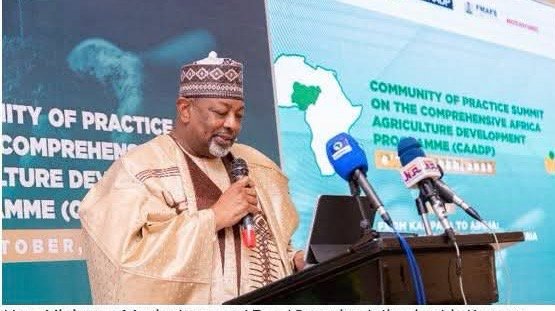
The support was disclosed at the Annual Community of Practice Meeting of Commissioners of Agriculture, Health, Environment, Commerce and Rural Development, on Monday in Maiduguri.
The Minister of Agriculture and Food Security, Sen. Abubakar Kyari, said the Community of Practice provided an important mechanism for translating the Federal Government’s national food security agenda into concrete action at state level.
The partnership is aimed at strengthening mechanisms connecting Federal Government institutions, state governments and non-state actors to ensure effective implementation of the Kampala Declaration and its 2026–2035 Strategy and Action Plan.
The initiative also supports alignment of Nigeria’s agricultural policies and development plans with the Kampala framework, which provides a continental roadmap for transforming Africa’s agrifood systems.
Germany’s support includes strengthening evidence-based implementation through the Comprehensive Africa Agriculture Development Programme (CAADP) Biennial Review, Joint Sector Reviews and consultations on Nigeria’s 2027 Food Systems Budget.
The Federal Government has been working to align national and state budgets with its 10-Year National Agrifood System Strategy and Action Plan, developed to domesticate the Kampala commitments.
Kyari said Nigeria required stronger alignment between Federal and State Governments through compatible policies, reliable data, complementary investments and clear responsibilities for implementation.
He said the Kampala framework placed emphasis on sustainable production, investment and financing, food and nutrition security, trade, inclusion, resilience and governance.
The minister urged state governments to align their action plans with national priorities in rural infrastructure, extension services, agricultural finance, quality inputs, mechanisation, post-harvest loss reduction and climate-resilient agriculture.
He said Nigeria had developed and validated a 10-Year National Agrifood System Strategy and Action Plan as the vehicle for implementing the country’s commitments under the Kampala framework.
Kyari also highlighted Federal Government interventions in fertiliser supply, mechanisation, irrigation, agricultural research and Special Agro-Industrial Processing Zones as part of efforts to strengthen food production.
Gov. Babagana Zulum of Borno, represented by his Deputy, Alhaji Umar Kadafur, said the implementation of the Kampala Declaration must translate into tangible improvements in farmers’ livelihoods and food security.
Zulum said Africa could no longer afford to treat agriculture merely as a policy issue, stressing the need for investment in improved seeds, irrigation, machinery, storage, markets and agricultural knowledge.
He said rebuilding agriculture in conflict-affected areas such as Borno required restoring farmers’ access to land, infrastructure, markets and livelihoods.
NAN reports that Germany’s wider development cooperation with Nigeria also includes support for agriculture and food systems, including post-harvest systems, climate-smart agriculture and agribusiness finance.
NAN