

Kidnappers Use Brutal Tactics to Prevent Victims’ Escape — Report
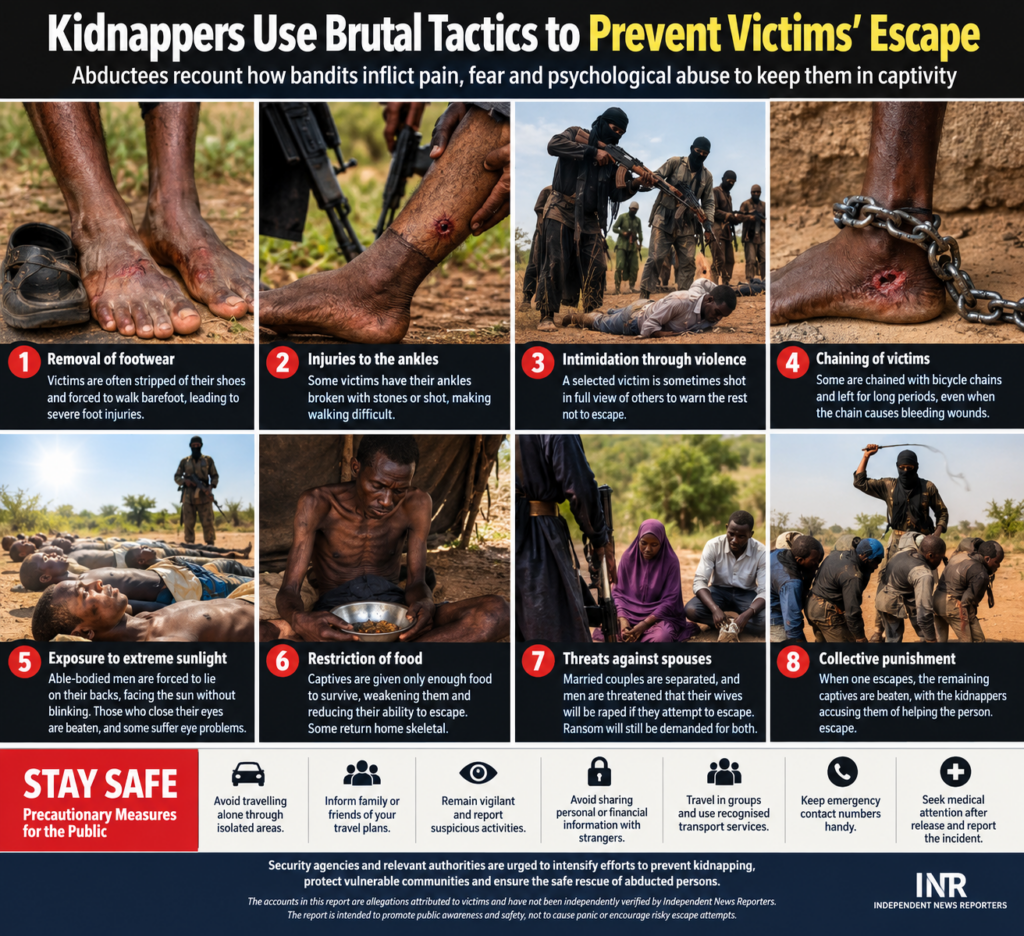
Kidnappers operating in remote bush locations allegedly use various forms of physical and psychological abuse to prevent abducted persons from escaping, according to accounts attributed to victims who regained their freedom.
The accounts highlight the need for members of the public to remain vigilant and take precautionary measures against kidnapping, particularly when travelling through isolated areas.
The information, circulated in a report based on interviews with victims who either escaped or were released after ransom payments, describes the methods allegedly used by kidnappers to weaken victims, intimidate them and discourage attempts to flee.
According to the report, the tactics include:
1. Removal of footwear
Kidnappers allegedly remove victims’ shoes to make movement difficult and discourage escape.
In some cases, victims are reportedly forced to walk barefoot over rough terrain from the point of abduction to the kidnappers’ hideout.
The report states that some victims sustained serious foot injuries as a result, requiring medical treatment after their release.
2. Deliberate injuries to the ankles
The report alleges that some victims are subjected to deliberate injuries to their ankles, including attacks with stones or gunshots.
Such injuries are said to make walking difficult and reduce the victims’ ability to escape.
3. Intimidation through violence
According to the accounts, kidnappers sometimes use severe violence against selected victims in the presence of other captives to discourage escape attempts.
The report alleges that such acts are intended to instil fear and convince victims that any attempt to flee could attract deadly consequences.
4. Chaining of victims
Some victims are reportedly restrained with chains, including bicycle chains, for prolonged periods.
The report states that the restraints can cause painful injuries to the skin, especially when victims remain chained for extended periods.
5. Exposure to extreme sunlight
The report further alleges that some kidnappers subject able-bodied male captives to prolonged exposure to direct sunlight as a form of punishment and intimidation.
Victims are reportedly ordered to lie on their backs and keep their eyes open while facing the sun.
The accounts claim that those who close their eyes may be beaten, with some victims allegedly suffering eye problems after their release.
6. Restriction of food
According to the report, captives are often provided with limited food, allegedly to keep them weak and reduce their ability to escape.
Some victims are said to return home severely malnourished and physically weakened after spending prolonged periods in captivity.
7. Threats against spouses and family members
The report alleges that when married couples are abducted, kidnappers may separate them into different locations.
It states that some male captives are threatened with harm to their wives if they attempt to escape.
Such threats are reportedly intended to discourage escape and compel victims to remain in captivity until ransom negotiations are concluded.
8. Collective punishment
The accounts further allege that when a captive escapes, kidnappers sometimes punish the remaining victims collectively.
The report states that other captives may be beaten or whipped on the grounds that they assisted the escape.
Precautionary measures
In view of the reported tactics, members of the public are advised to take the following precautions:
* Avoid travelling alone through isolated roads and unfamiliar bush paths, especially where kidnapping incidents have been reported.
* Inform trusted family members or friends of your travel plans, route and expected arrival time.
* Remain vigilant and report suspicious movements or activities to security agencies.
* Avoid discussing personal financial details, travel plans or valuables with strangers.
* Where possible, travel in groups and use recognised transport services.
* Keep emergency contact numbers readily available.
* If abducted, avoid unnecessary confrontation with kidnappers and prioritise personal safety.
* When a safe opportunity to escape arises, carefully assess the risks, including the presence of armed guards, physical injuries and the safety of other captives.
* After release, seek medical attention for injuries and report the incident to the appropriate security authorities.
Security agencies and relevant authorities are urged to intensify efforts to prevent kidnapping, protect vulnerable communities and ensure the safe rescue of abducted persons.
Disclaimer: The accounts contained in the report are allegations attributed to victims and have not been independently verified by Independent News Reporters. The report is intended to promote public awareness and safety, not to cause panic or encourage risky escape attempts.