
NHRC, UNHCR Train Stakeholders on Human Rights Protection for Displaced Persons
By Ahmed Kaigama
The National Human Rights Commission (NHRC) and the United Nations High Commissioner for Refugees (UNHCR) have trained stakeholders on crowd-sourcing mechanisms to strengthen human rights protection for displaced persons in Borno.
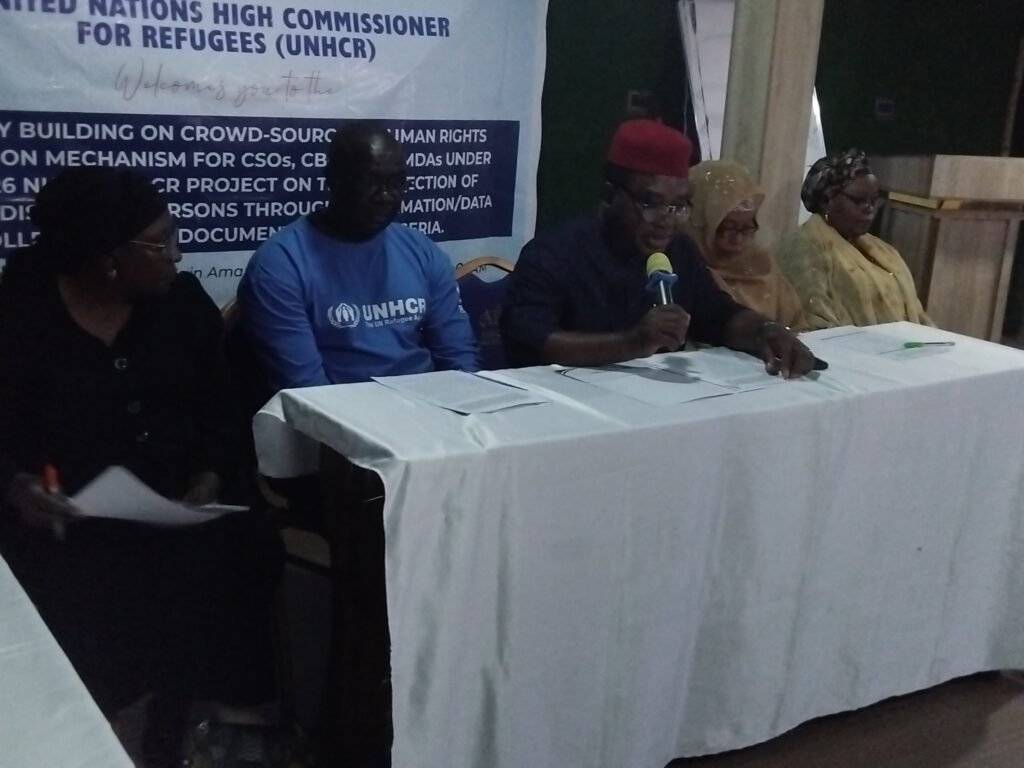
The two-day capacity-building programme brought together representatives of civil society organisations, community-based organisations, ministries, departments and agencies, Community Protection Action Groups and human rights monitors.
Speaking at the opening, the Executive Secretary of NHRC, Tony Ojukwu, said the training was designed to equip participants with skills for gathering, verifying, documenting and securely transmitting information on human rights violations.
Ojukwu said the initiative was part of the 2026 NHRC-UNHCR project aimed at strengthening early warning and rapid response systems through timely reporting of security incidents, displacement movements and protection concerns.
He said persistent conflicts and insecurity had continued to expose internally displaced persons and other displaced populations to risks, including sexual and gender-based violence and limited access to healthcare, education, shelter, justice and documentation.
According to him, participants will be trained on ethical information gathering, confidentiality, verification processes and the use of digital tools for prompt and secure reporting of incidents.
“The objective is to improve the reporting system and strengthen the alert mechanism so that information reaches responders faster.
“Timely information and timely intervention can save lives and reduce suffering among displaced populations,” he said.
Ojukwu said the crowd-sourcing approach would transform community members and frontline actors into an effective early warning network capable of detecting and reporting protection concerns in hard-to-reach areas.
Also speaking, Daniel Bisu, Assistant Protection Officer, UNHCR Maiduguri, urged participants to promptly report human rights violations.
He said delays in reporting often deprived victims of timely assistance and protection.
Bisu said the training would expose participants to practical methods of documenting and reporting violations through accessible and trusted channels.
He added that the approach would enable response agencies to provide legal, medical and psychosocial support to affected persons.
In her remarks, Habiba Ghana of the Borno State Ministry of Justice described the training as a welcome initiative.
She said the programme would strengthen stakeholders’ capacity to promote and protect human rights within their communities.
Ghana urged participants to apply the knowledge gained to address human rights violations and improve protection outcomes for vulnerable populations.